What does the future hold for department stores? Reinvention, repurposing?
Advertisement
Experiences
What does the future hold for section stores? Reinvention, repurposing?
Sure, department stores equally we've known them might non survive. But their future could be far more interesting. Equally one writer points out, empty retail units make perfect spaces for art, theatre, workshops or even retirement homes.
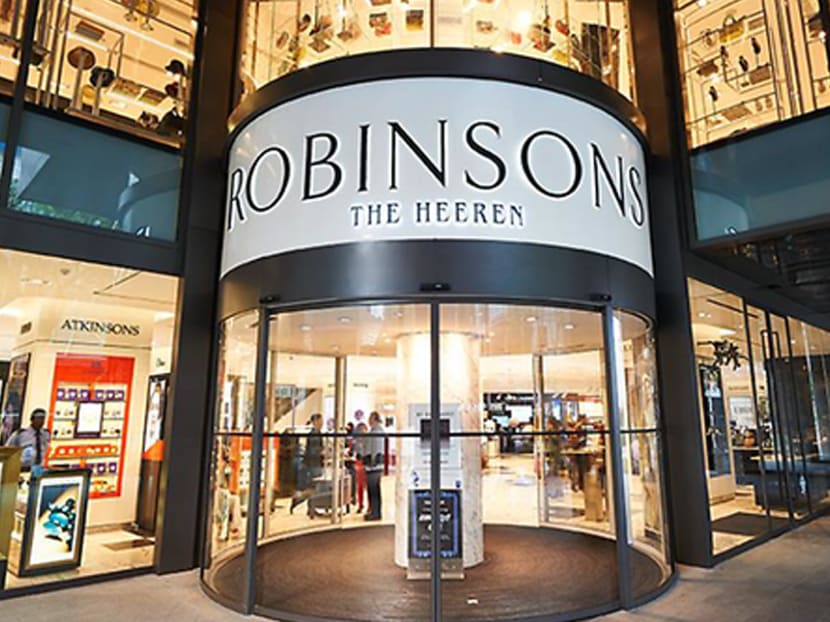
The former Robinsons store at The Heeren. (Photo: Robinsons)
When the beginning neat department stores opened in Paris and the US in the belatedly 19th century, they were like null that had been seen. There were cafes, restaurants and smoking rooms, fountains and winter gardens, luxury goods that customers could scan without being bothered by staff.
There were fifty-fifty ladies' lavatories: Women could spend an entire day in town in safety and without moral opprobrium. A glimpse of lifestyles that had previously been available simply to the elite was now on view to almost anyone who strolled in.
READ> Livestream sales of luxury items are popular in Communist china, but not Singapore. Why?
It'due south difficult to reconcile all this with the dying department stores that now loom, unloved, in cities, towns and suburban malls. A walk through primal London takes you past the dead hulk of Debenhams on Oxford Street and the soon-to-shut erstwhile Army & Navy in Victoria. Edinburgh has lost Jenners.
Information technology's perhaps even worse in the US: The ailing JC Penney has closed more than 160 stores, Neiman Marcus has been battling with defalcation and restructuring, and other in one case-mighty names are in trouble. One estimate suggests that 800 US department stores may close during the side by side five years – roughly half the remaining mall-based total.
READ> Robinsons Singapore is back – as an online section store
The pandemic retail apocalypse has been written about extensively, simply what about the architectural losses? While Selfridges has recently been granted a licence to host weddings at its swaggering Edwardian Oxford Street headquarters, too as experimenting with pop-ups and opening a vegan butcher, Marks and Spencer is demolishing some of its landmark stores and replacing them with generic mixed-utilise buildings that have little of the flair of the originals.
Gems such as the streamlined 1930s Debenhams in Taunton, due south-west England, face uncertain futures. The trend appears to be to let these buildings go: Only as the retail globe has moved on, these cavernous carcasses should exist knocked down or gutted to make room for something else.
READ> Will department store shopping ever be the same in the post-pandemic era?
Is this the only selection? Also equally beingness architecturally significant, these remarkable buildings are an incredible resource. They may be desolate now, but myriad fascinating futures are possible.
Take Paris'due south La Samaritaine, a one thousand, 70,000 sq m circuitous of Art Nouveau and Art Deco buildings in the first arrondissement, which opened in 1870 and grew to go 1 of the architectural wonders of its historic period.

Later on a lengthy and controversial redesign procedure, information technology finally reopened this twelvemonth, wrapped in rippling, translucent drinking glass designed by the Japanese architects SANAA. A luxury hotel, a remodelled store and offices are function of the scheme; more surprisingly, perhaps, it also includes 96 social housing units and a plant nursery – an impressive intervention in a sensitive historic site.
There are more experimental possibilities, as well. Kathryn Bishop of strategic consultancy The Future Laboratory points to projects where department stores have been converted into retirement homes or sheltered accommodation.

The Folkestone senior-living customs in Wayzata, Minnesota, is a former mall, its brick-faced blocks offering a simulacrum of urbanity. "Many Americans over 55 don't want suburban bungalows merely sidewalks and shops," she said. "Nosotros might see health and wellbeing much more integrated in the streets."
Another possibility is culture. Might not empty retail units make perfect spaces for art, theatre, workshops? In that location are large windows for studios and brandish, and deep floor plates for galleries. Museums are keen non to be perceived as exclusive – what better way to nowadays their treasures to the public than on high streets? Or possibly spaces in less residential areas could transform into nightclubs, which accept been shut down by the pandemic. After all, nightlife always appropriates spaces conceived for other uses.

What went incorrect with traditional section stores in western cities? It seems obvious to blame the huge growth in online shopping – accelerated past the pandemic – but Vicki Howard, an academic at the Academy of Essex and the author of From Master Street to Mall: The Rise and Fall of the American Section Store, identifies a longer, sorrier history. This reaches back to the tardily 20th century, when debt-driven expansion enabled major retail players to swallow upward local brands, creating identikit stores that were shadows of their quondam selves.
"Businesses took every opportunity to strip abroad those costly amenities which had made them luxurious – the service, the training of the staff," she said. "Then they expanded into the suburbs, where they built windowless boxes, maximising flooring and display space in the eye of a automobile park. The materials they used didn't stand the test of time and they concluded up as strip malls."
This shift from city centres was faster in the US, but it hasn't been entirely one-way, Howard adds: In the past decade, as downtowns have been gentrified and revitalised, abandoned malls have been redeveloped as well. The Mall of America in Minnesota, the state's biggest, filled upwardly some of its empty spaces with a large walk-in health dispensary in 2019, a move that looks prophetic in low-cal of COVID-19.
If the idea of the department store itself is to suffer, it is going to have to change. For some, this might mean prioritising luxury. The success of London's Dover Street Marketplace, created past Comme des Garcons founder Rei Kawakubo and her husband Adrian Joffe in Mayfair, has established a model for the department store equally a loftier-concept, high-pattern hang-out, closer to an art gallery than a shop and mixing streetwear with haute couture.

Dover Street Markets have now materialised in locations including Singapore, Tokyo, Beijing and LA. In New York, Roman & Williams' Lafayette Street outlet offers antiques, crafts, art, dining and blueprint in an upmarket interior which has something of the crowded luxury of the grandest 19th-century stores.
London-based architecture do Sybarite is building a number of audacious retail spaces in Red china, some repurposed from older structures. Sybarite's stores recall the ambition of the golden era of Selfridges and the similar – if not the aesthetic.
One projection for the high-end shop brand SKP-Southward brings sci-fi fantasy to cardinal Beijing: A "Mars zone" features life-size model space vehicles, accommodation modules and immersive evocations of the Martian landscape; its snaking corridors look like something from Star Wars.
Sybarite co-founder Torquil McIntosh explains that Chinese consumers, once derided for copying western fashions, are now leading the mode in retail. "The Chinese have understood that people just want to take fun, spend a day out and Instagram the hell out of everything," he said. "Customers switch between their phones and the existent environment and back every second."

For other projects, the key will be location. Bishop identifies a phenomenon she refers to as "small box stores". If the past few decades were dominated by suburban malls filled with huge DIY outlets, home-furnishing outfits and discount hypermarkets, many of these businesses have been trying to get back into city centres – "even Ikea", Bishop pointed out.
The fact that so many of u.s. have been working from domicile during the pandemic has had a revitalising outcome on local loftier streets, with workers popping out to shops and cafes nigh where they live. Stores and big brands might accept to come to us rather than expecting us to go to them.
Empty shops are commonly seen every bit an indicator of economical blight but, looked at another manner, they are spaces of opportunity. It will take subtle shifts in regulation and developers' mindsets – away from relying on financially leveraged global brands paying assured rents.
It will as well take date from local authorities and communities, committed to maintaining these distinctive and often historic structures on their streets. And it will need a new, nimble entrepreneurialism. Certain, department stores equally we've known them might not survive. But their futurity could be far more than interesting.
Past Edwin Heathcote © 2022 The Financial Times
READ> Why eastward-commerce volition never completely replace brick-and-mortar shopping

Recent Searches
Trending Topics
Source: https://cnalifestyle.channelnewsasia.com/experiences/what-does-the-future-hold-for-department-stores-249251
0 Response to "What does the future hold for department stores? Reinvention, repurposing?"
Post a Comment